
51: Designing thoughtful technology for conversation in noisy places
Cybernetic "Blue Team" Makers Project: Café Ears

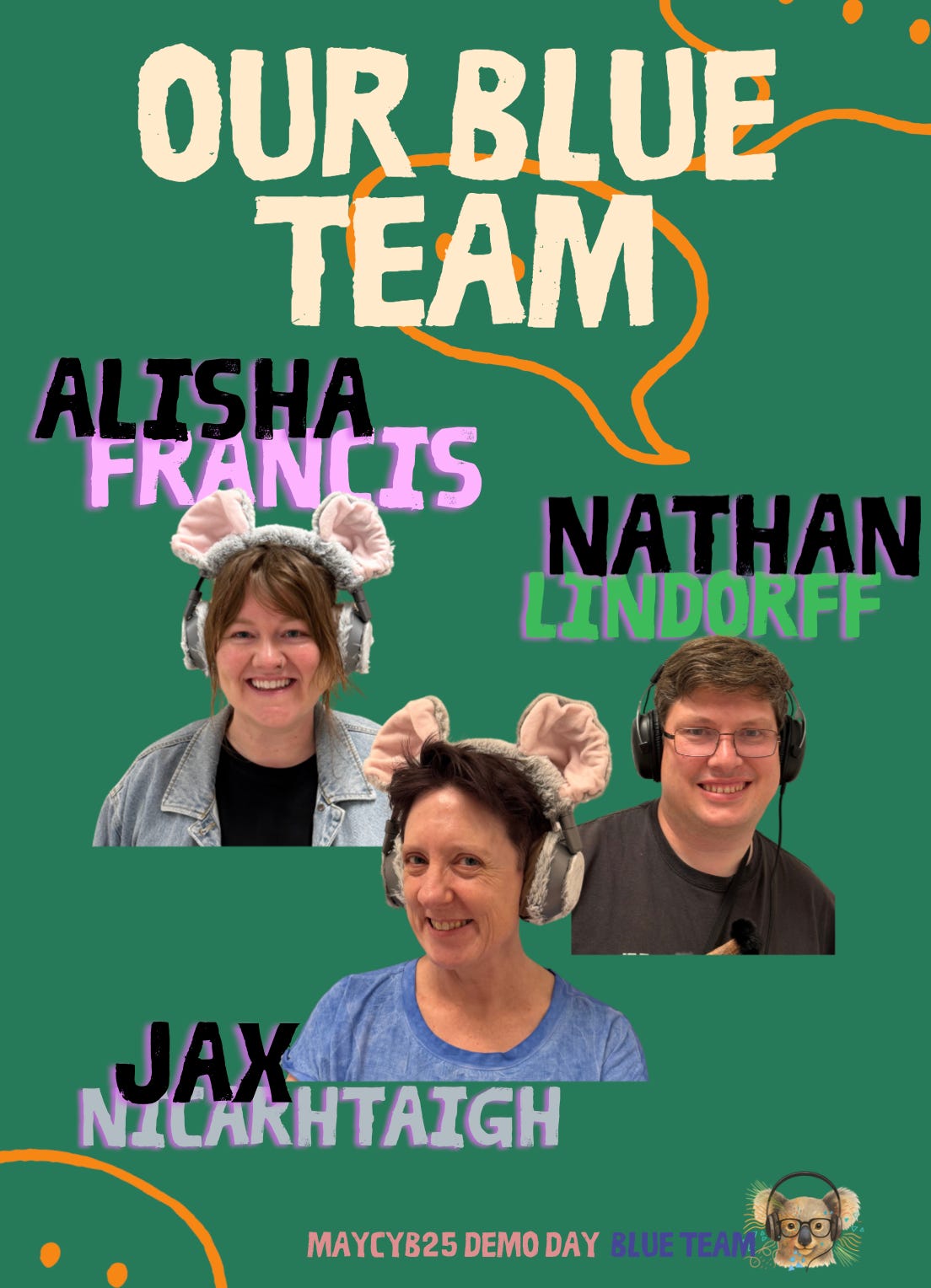
One of the highlights of my time in the Master of Applied Cybernetics was collaborating with Alisha Francis and Nathan Lindorff to design and build a novel piece of technology: Soundscape “Café Ears”.
Together we formed “Blue Team” and created a small experimental brand called SoundScapes, imagining a range of wearables for people who struggle to hear in restaurants, busy functions, and conferences — even when they don’t identify as having hearing loss.
It turns out many people quietly avoid these environments because conversation becomes exhausting.
We wanted to explore a different possibility.


Slow collaboration, then a sudden leap
True collaboration goes slow, slow, slow — and then very fast.
Our project followed this rhythm.
We spent much time researching everyday listening challenges, exploring the problem space, and deciding what we actually wanted to solve. Only then did we begin experimenting with ways to build a device that could make conversation easier in noisy environments.
Along the way we also asked a second set of questions:
Could we build something that worked well, but also used simple, accessible components?
Could it be environmentally thoughtful?
Could it be affordable?
What people told us about hearing in public
As we circled on the idea of wearable hearing technology, we decided to test the idea out beyond ourselves. We sent out a short survey asking what hearing better in busy environments might mean for them. The answers were unexpectedly emotional.
“I might be able to go on dates again.”
“I could finally meet friends somewhere I’d usually avoid.”
We found that hearing meant genuine connection and even a rediscovered ability to go out and meet people in public. The issue was more about connection and belonging.
Introducing Café Ears
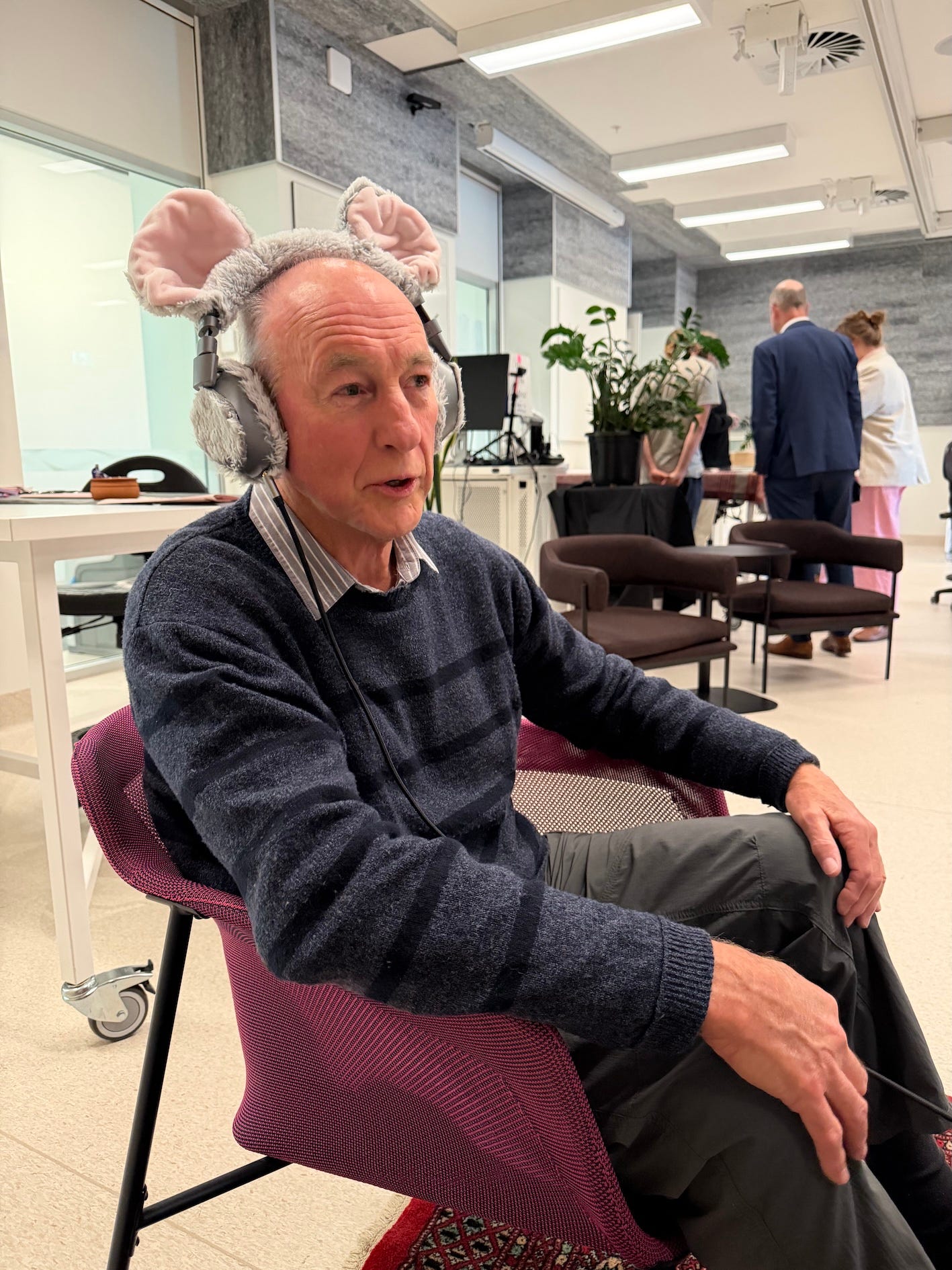
Our prototype, Café Ears, combined playful design with practical intent.
We made the headset by refurbishing an older model of noise defenders and soft fabric destined for landfill. We sourced electronics economically and supervised AI agents to help us code the device so it could amplify the speaker’s voice while reducing background noise.
In its simplest form, Café Ears works like this:
A wearer puts on the “Koala” headset.
The person they are speaking with wears a small microphone “Joey pouch” and speaks normally.
The voice arrives clearly through the headset, even in a noisy environment.
Instead of straining to pick one voice out of a wall of sound, the conversation becomes easy again.
For the technically minded, Café Ears and the Joey Mic can be understood as cyber-physical systems. They:
Sense — capturing environmental signals such as surrounding audio and user input
Process — computing and interpreting those signals using embedded hardware (e.g. an ESP32 microcontroller)
Actuate — transforming that processing into a physical outcome, delivering clearer, prioritised sound to the wearer
These systems form a feedback loop, continuously sensing, processing and adjusting in response to changing environments.
What cybernetics meant in practice
Because of the word “cyber” in cybernetics, most people assume that our work is all about AI or building technology. Over the year in the Master of Applied Cybernetics, we learned to think and work together without collapsing into group think or defaulting to the loudest voice.
Through the process we learned to:
ask better, and sometimes harder, questions
slow down and listen to one another
experiment with ideas rather than defend them
test prototypes with real people
move beyond the need to have a single supervisor or leader — we all led
In other words, we were designing a system together — not just a device from one person’s idea.
“Oh — I can hear you” — Demo Day at ANU


The real turning point came on Demo Day when we shared Café Ears with a public audience.
At first glance, the prototype looked a little whimsical. The furry ears gave it a playful character.
Then people started trying it.
One after another, in the middle of a noisy room, people put on the headset and said the same thing:
“I thought it was my hearing!”
That moment of surprise told us something important.
We’d made something that went beyond a gimmicky gadget. Person after person told us that Café Ears was revealing how they quietly struggle with conversation in loud environments, and thinking that it was them. “You solved a problem I never knew I had!” said one man on Demo Day.
Designing something simple
We didn’t start with Café Ears. Instead we started with a question. We asked: What would it take to help someone hear one person clearly in a complex soundscape?
We checked what was on the market and cross-referenced with what others told us. Many hearing technologies focus on blocking noise or enhancing hearing generally. Some that seem to do better are astronomically expensive.
So we focused on a few principles.
What we designed for
Plug-and-play simplicity
Affordable components rather than specialised hardware
Small, sensitive, energy-efficient electronics
Replicable designs that others could iterate on
Signal integrity through component placement
Consent-based interaction — the speaker chooses to hold the mic
The furry ears of our prototype followed a playful trend in wearable fashion, but other (future) versions could be designed for other audiences.
We imagined possibilities such as:
sportscaster-style headphones
subtle wearable devices
microphones integrated into clothing or hats
multi-person “soundscape” systems allowing several people to tune into each other at a gathering
Combined with an attractive and intuitive app on a phone or device that could be controlled by one wearer or perhaps shared around friends, we figured this might be a nightclub hit.


Designing for real environments
Of course, the deeper solution needs to go beyond individual technological solutions to modifying the environment. Ideally, we would design restaurants, meeting spaces, and social venues that support conversation naturally. These are easy to do — soft covering design for example — but with even our best efforts will change too slowly for ease of hearing right now.
In the meantime, small human-centred technologies can help people stay connected. Café Ears is our experimental offering in that direction.
What happens next
While Soundscape “Café Ears” began as a student project, we now know that the idea has clear potential for further development. We are open to conversations with collaborators, designers, technologists, and investors interested in exploring the next stage of this work.
Because sometimes the most meaningful technology is the kind that helps people do something simple again: hear each other.
ANU Open Day — 28 March 2026
You can try Soundscape “Café Ears” for yourself at the ANU Open Day 2026 at the ANU Acton campus in Canberra from 9am-3pm on Saturday 28 March 2026. Come and say hello!
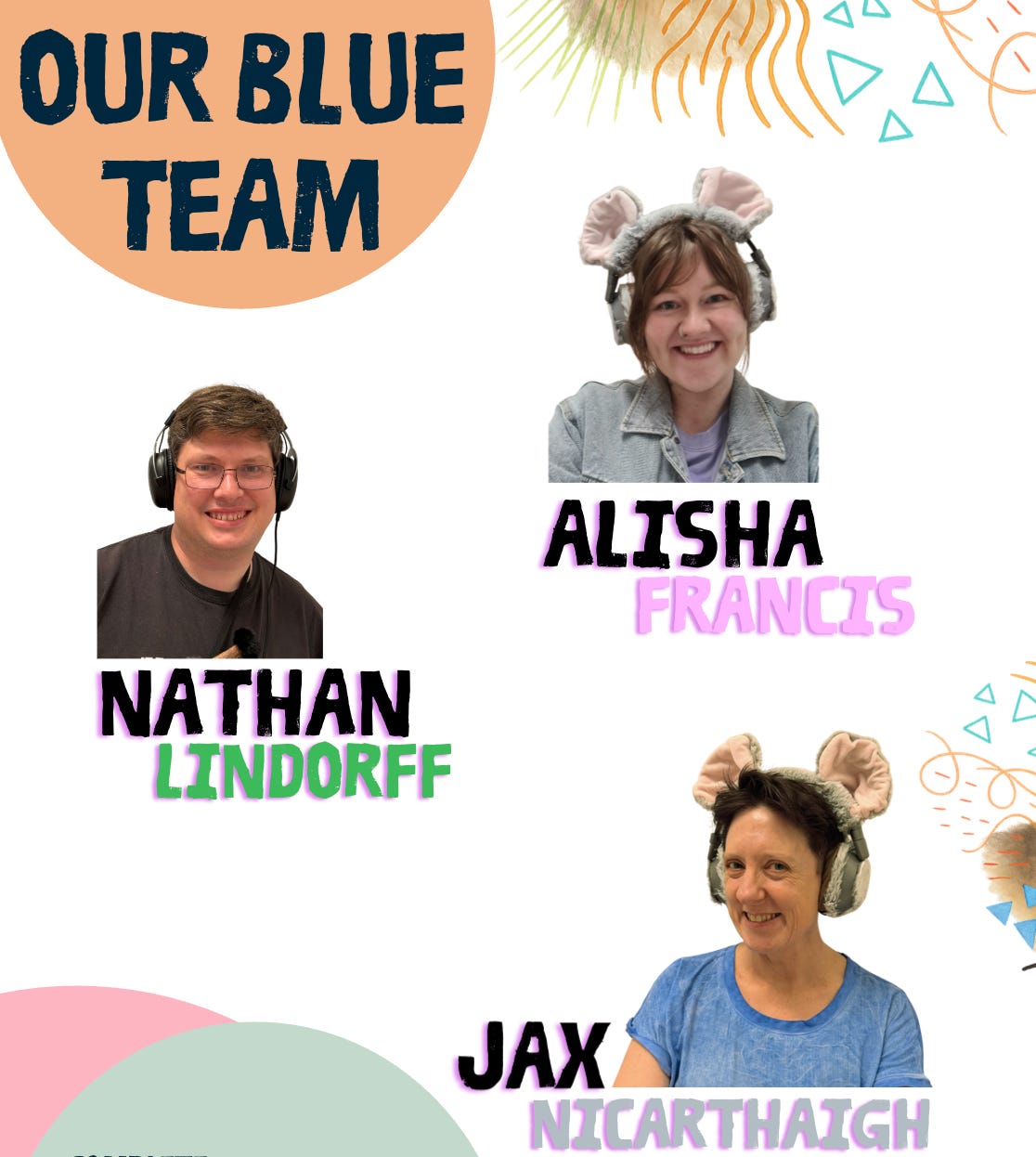
Alisha Francis, Nathan Lindorff, Jax NiCarthaigh
Your turn
So, what do you think of this concept?
Can you hear in noisy places?
What do you do (or don’t do)?
Would you use wearables to speak and be heard clearly?
A final thanks
Lastly, thank you to all our teachers and to our fellow MAYCYB25 students for all your support and encouragement. Thanks to our friends and families for coming along to Demo Day and backing us all year long!
This article is written with the assistance of artificial intelligence. I take full responsibility and claim full authorship of my work.
📖 More Jax insights on Medium and LinkedIn
📸 My photos— Flickr
I really love this concept Jax.
In the work we do with our connection idea games, being able to hear each other clearly is one of the core design conditions for participation, whether that’s in a classroom or a public gathering space. If people can’t hear, it can stop them from sharing memories and ideas.
Separately, I’ve also heard from an educator working alongside intergenerational programs that this is a real challenge. Soft voices, busy environments, and the effort it takes to follow conversation can make it harder for both older people and children to fully engage, even when they want to.
What you’ve created opens up new possibilities for participation. Not just in terms of hearing, but in who gets included in the conversation and who gets to imagine and contribute ideas.
It also makes me think about what happens to the ideas once they’re spoken. In many conversations, people generate thoughtful, creative ideas about their environments that aren’t captured and can easily disappear. There may be something interesting in how tools like this could support not just hearing, but holding onto those ideas as part of shaping shared environments.
I’d love to see where this goes, and how it might be explored in community settings.
Thanks Fi. So many rich ideas here. I really like how you can see the breadth of ways of listening clearly. You are right. There are so many opportunities to discover new ways of being together and communicating. We explored a lot fit eh visual signalling too. When you were the Cafe Ears headset, it says "I'm up for a conversation!" Different to other headsets which indicate "do not disturb".
I hope you can come on open day and give Cafe Ears a go.
:-)
Best,
Jax